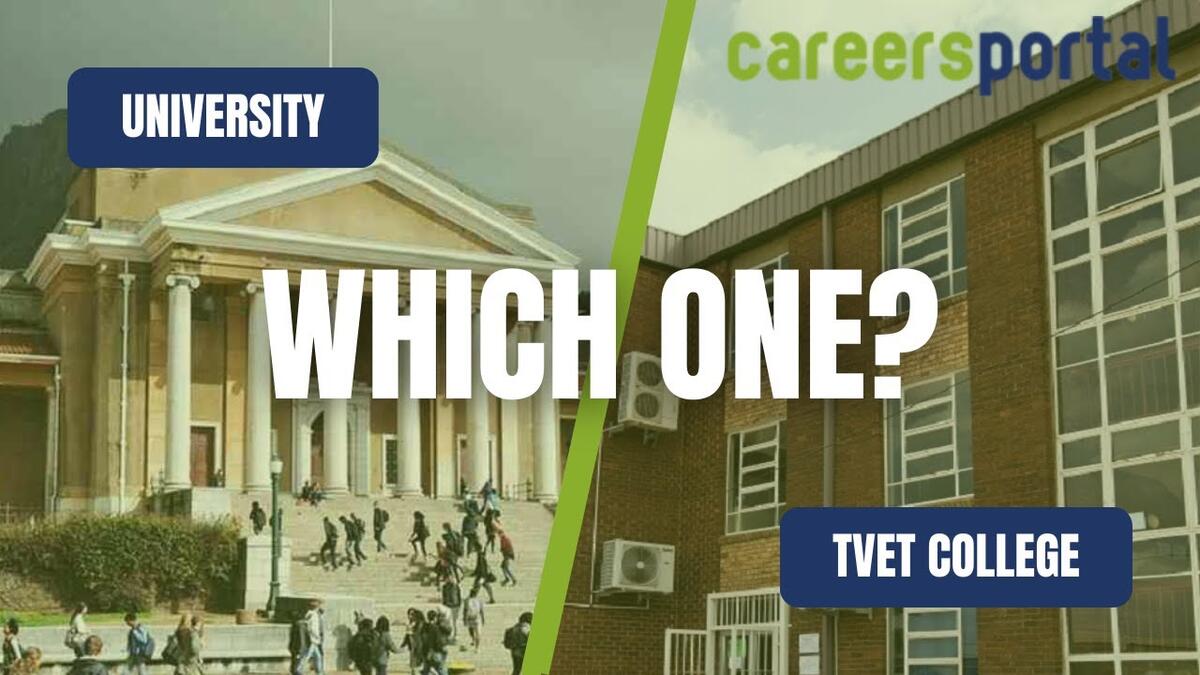
The choice between attending a university or a TVET college will depend on a variety of factors, including your academic interests, career goals, financial situation, and learning style. Once you have accessed those elements, you would know more or less which educational environment suits you.
Let us have a look at the advantages and disadvantages of attending a university or TVET college to help you make an informed decision:
Universities
Universities are typically three- or four-year institutions that offer a wide range of degree programs, from Bachelor's to PhDs. They tend to be more academic in nature, focusing on theoretical knowledge and research.
hey offer a variety of disciplines, such as engineering, medicine, business, law, and humanities.
Advantages of attending a university include:
-
Academic discipline: Universities offer a high level of academic intensity and intellectual challenge, which can be appealing to students who are seeking a challenging intellectual environment.
-
Reputation: Universities are often more prestigious than TVET colleges, which can be important in certain fields.
-
Career opportunities: Universities offer a wider range of career opportunities than TVET colleges, particularly in fields that require a higher level of education, such as medicine, law, and academia.
Disadvantages of attending a university include:
-
Cost: Universities are often more expensive than TVET colleges, which can be a barrier for students who are on a tight budget.
-
Academic pressure: The academic pressure at universities can be intense, and some students may find it difficult to keep up with the pace of coursework and research.
-
Requirements: To attend a university and study towards a Bachelors degree, students would have needed to achieve a Bachelors pass in matric. Sometimes, the university requirements for admission can be tough.
TVET Colleges
TVET colleges are vocational institutions that offer certificate, diploma, and degree programs in a range of technical and vocational fields, such as engineering, agriculture, hospitality, and business. They tend to be more hands-on in nature, focusing on practical skills and training for the workforce.
Advantages of attending a TVET college include:
-
Cost: TVET colleges are often more affordable than universities, making them a more accessible option for students who are on a tight budget.
-
Practical training: TVET colleges offer more hands-on, practical training that is directly applicable to the workforce.
-
Job opportunities: TVET colleges often have strong ties to local industries, which can lead to better job opportunities for graduates.
-
Matric: For some TVET college courses, matric is not a requirement. The minimum requirement to attend a TVET College is to have a grade 9 certificate.
Disadvantages of attending a TVET college include:
-
Limited range of programmes: TVET colleges offer a more limited range of programs than universities, which may not be suitable for students who are interested in pursuing more academic or specialized fields.
-
Perception: There is still a perception among some people that TVET colleges are not as prestigious as universities, which may be a barrier for students who are seeking validation and recognition for their education.
If you are interested in pursuing a more academic or specialized field, and have the financial means to do so, a university may be the best option for you. However, if you are interested in pursuing a vocational or technical field, and are looking for a more affordable and hands-on education, a TVET college may be the best fit.